Most disinfectants are foreign chemistry — invented in a lab, tested for compatibility with human cells, and then deployed with warnings about ventilation, PPE, and contact time. Hypochlorous acid is different. Your own body manufactures it.
When white blood cells encounter pathogens, they synthesize hypochlorous (HOCl) inside specialized compartments and use it to neutralize the threat. It is, in a real sense, the molecule your immune system trusts. The same chemistry, made shelf-stable in a tablet and dispersed as a 1–3 micron mist, is what GEIA dry misting systems deliver across air and surfaces.
Why the Chemistry Matters
Two things make hypochlorous unusual: it's up to 80x more powerful than bleach, and it does this work at a pH that's almost identical to clean water.
Bleach (sodium hypochlorite, NaOCl) and hypochlorous acid (HOCl) share an atom — but the charge tells the whole story. Bleach carries a negative charge. So do most bacterial cell walls. Like-charges repel, so bleach has to work hard, at high concentrations, against pathogens that physically push back.
Hypochlorous is neutral. It walks straight to the cell wall and oxidizes it from the outside. Less concentration, less contact time, and dramatically less collateral damage to surfaces, fabrics, and the people standing nearby.
Why Dry Misting Specifically
HOCl as a liquid has been used in food processing, healthcare, and water treatment for decades. The breakthrough that GEIA built around is delivery: dispersing it as a 1–3 micron dry mist that behaves like a gas rather than a liquid.
At that droplet size, the mist:
- Reaches every wall, ceiling, vent, and fabric surface — not just what a sprayer can hit
- Treats the air people are actively breathing
- Evaporates without leaving puddles, streaks, or residue
- Operates while the room remains occupied — no clearing students, patients, or guests
That last point is the wedge against electrostatic sprayers and conventional foggers, both of which require the space to be cleared during application. GEIA's whole-space coverage happens around people, not in spite of them.
What About Safety?
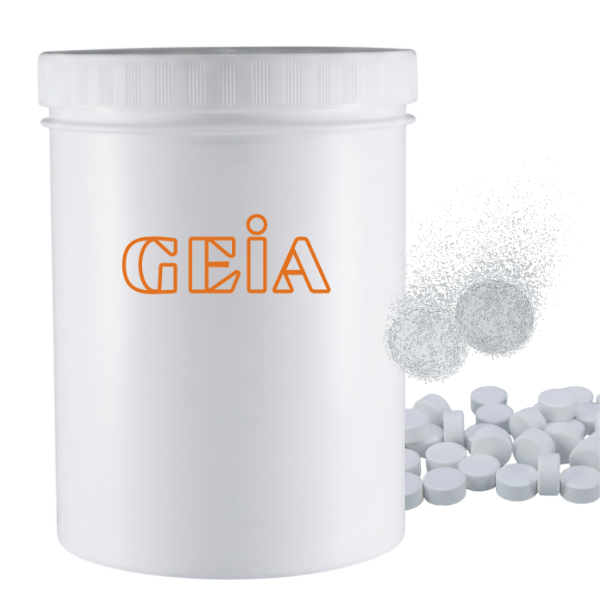
Hypochlorous at the working concentration GEIA systems produce is near-neutral (around 6.5 pH). It leaves no residue, breaks down to ordinary saline, and carries no chronic toxicity signal. Distributors load GEIA systems with EPA-registered HOCl chemistry — 3.3g Tablets, 6.5g Tablets, other EPA-registered tablets, ready-to-use HOCl, or on-site HOCl generation — all documented in their respective master labels.
One caveat that GEIA is honest about: this isn't a replacement for cleaning. Heavy organic soil reduces hypochlorous effectiveness. Pre-cleaning is still required per EPA label for surface disinfection claims. GEIA dry misting is an additional layer — infrastructure that elevates an existing protocol, not a shortcut around it.
The Bottom Line
Hypochlorous is what happens when nature and chemistry agree. It's how your body fights infection. It's measurably more powerful than bleach. It's safe enough to run while people are in the room. And, dispersed as a dry mist, it reaches places traditional cleaning was never able to touch.
If you want to see how this works in your specific facility — a classroom, a hospital floor, a hotel tower, a barn — request a quote or schedule a demo. We'll mist your space while you watch.