
What Is Hypochlorous?
The same molecule your immune system makes to defend you — near-neutral, residue-free, and safe around people, animals, and food. It's the chemistry GEIA dry misting puts to work on the whole room.
Not a lab invention. A defense you already run.
Hypochlorous is the compound your white blood cells produce to neutralize what they find — then it breaks back down into harmless salt water. Same chemistry, now spread across the whole room.
A powerful disinfectant. Naturally safe.
Hypochlorous acid (HOCl) is a naturally occurring disinfectant — up to 80× more powerful than bleach — yet it's pH-neutral and non-toxic. It's the very same molecule your immune system makes to defend you, and nature builds it from nothing more than salt, water, and a little electricity. Powerful and sustainable. Safe and effective.
Up to 80× more powerful than bleach
A fast, potent oxidizer — hypochlorous goes to work in milliseconds, far more efficiently than chlorine bleach at the same concentration.
pH-neutral, non-toxic & safe
Near-neutral pH (~6.5), no harsh fumes, and no residue — safe around people, animals, and food, and gentle enough to run in occupied rooms.
Naturally made & sustainable
The same molecule your body produces — made from just salt, water, and electricity, then breaking back down into simple saline. Nothing harsh left behind.
Hypochlorous, explained.
A few short videos on what hypochlorous is, where it comes from, and why it's the right chemistry for treating a whole environment.
The same job, without the harshness.
Both are chlorine-based oxidizers. The difference is what they leave behind — and whether people can stay in the room.
- ✓Near-neutral pH (~6.5) — gentle on skin, eyes, and surfaces
- ✓Breaks down to plain saline — no residue to rinse or wipe
- ✓No harsh smell — designed to run in occupied spaces
- ✓The same molecule the human immune system produces
- –Strongly alkaline (pH ~11–13) — irritating to skin and airways
- –Leaves salt residue and can bleach fabric and finishes
- –Sharp fumes — spaces usually need to be cleared
- –Corrosive to many metals over time
Each chemistry has its place. HOCl is the right answer when you need ongoing environmental treatment in occupied spaces — no harsh smell, no surface damage, no residue.
Three ways to source the same molecule.
GEIA equipment is source-agnostic — it disperses hypochlorous the same way no matter where the solution came from. Target working concentration is 294 ppm; equipment maximum is 300 ppm.
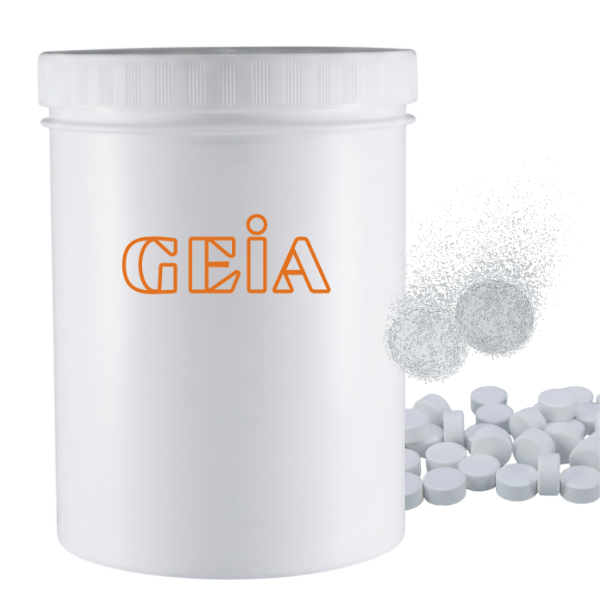
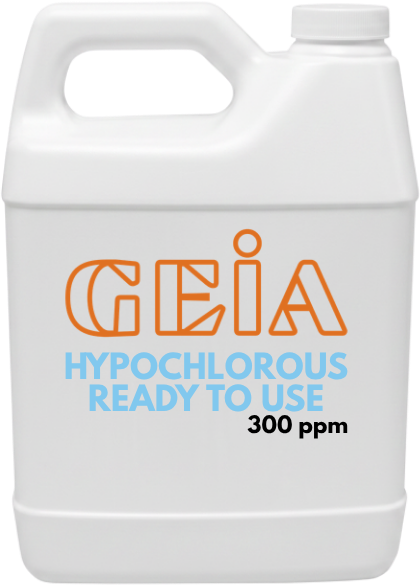
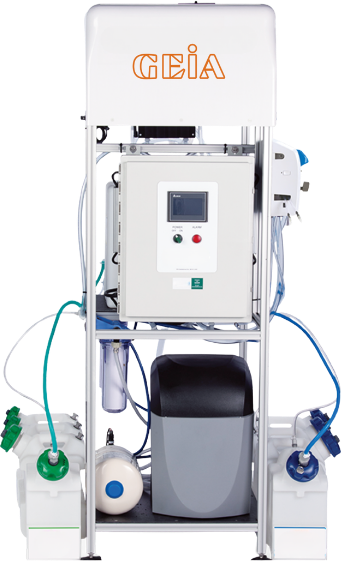
Spread across the whole room.
A wipe treats what you can reach. GEIA dry misting atomizes hypochlorous into a 1–3 micron dry mist that fills the full volume of a space — air, surfaces, and the corners a cloth never touches — then settles and dissipates. It works as a layer on top of your standard cleaning, never as a replacement for it.
Your Body Already Makes the Same Stuff GEIA Uses
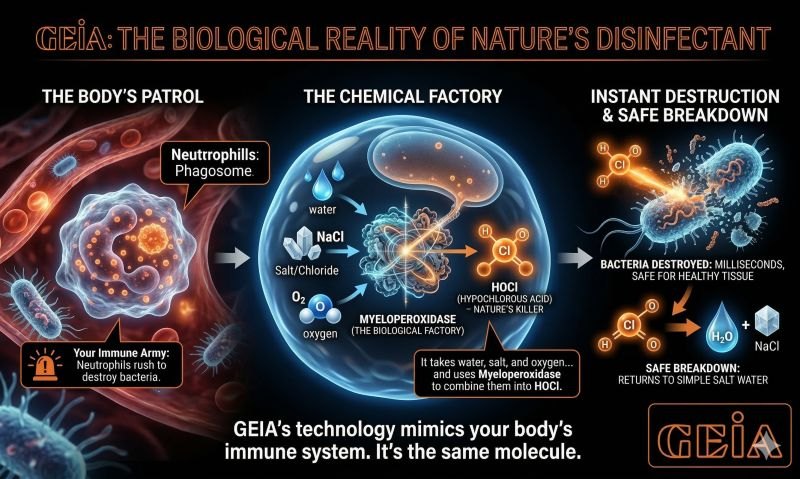
Think of your immune system like a tiny army living inside your blood. The soldiers are called neutrophils — and their whole job is to hunt down and destroy bacteria that sneak into your body.
When a dangerous bacteria (like meningitis) shows up in your bloodstream, your body sends out an alarm and thousands of these soldiers rush to the scene.
Here's where it gets cool.
When a neutrophil catches a bacterium, it doesn't punch it or shoot it. Instead, it swallows it whole — like a Pac-Man eating a ghost — and traps it in a little bubble inside itself.
Then the neutrophil does something remarkable. It runs a tiny chemical reaction inside that bubble: It takes water, salt (the chloride part), and oxygen — stuff that's already floating around in your blood — and it uses a special enzyme called myeloperoxidase like a little biological factory to combine them into HOCl.
That's hypochlorous acid. The exact same molecule GEIA puts in its machines.
The neutrophil then floods that bubble with HOCl, and the bacteria is destroyed almost instantly. Its proteins fall apart, its cell walls dissolve, it can't replicate — it's done.
The punchline?
Your immune system didn't pick HOCl by accident. It evolved to use it because, after billions of years of trial and error, HOCl turned out to be the most effective way to kill pathogens without wrecking the surrounding healthy tissue. It's powerful enough to destroy bacteria in milliseconds, but it breaks down into simple salt water almost immediately after it does its job.
GEIA's technology isn't mimicking a chemical — it's mimicking your own immune system.
Ready to put hypochlorous to work?
Tell us your facility and what you're trying to solve. We'll help you pick the right chemistry source and the GEIA equipment to disperse it.
Get a Quote