GEIA Dry Misting vs. UV Light Disinfection
UV light disinfection systems and GEIA hypochlorous dry misting solve the same problem in fundamentally different ways. This page walks through where each wins.
The 30-Second Comparison
| Criterion | GEIA Dry Misting | UV Light Disinfection |
|---|---|---|
| Coverage type | Whole-space (mist reaches every surface and air) | Line-of-sight only — UV must illuminate surfaces directly |
| Treats the air | Yes — whole-room air | Partial — only air passing through the direct UV beam (line-of-sight) |
| Treats fabric, vents, ceilings, crevices | Yes | Limited (shadowed surfaces missed) |
| Treats odors | Yes (oxidizes odor molecules at source) | No |
| Room must be cleared | No (occupied-space safe) | Yes (UV exposure risk) |
| Time per typical hospital room | Minutes | 15–45 min per device cycle (multiple positions often required) |
| Labor required | Minimal — runs on schedule | Higher — device must be repositioned between zones |
| Upfront cost (per room) | Lower | Higher — a major capital purchase per device |
| Consumables | EPA-registered HOCl tablets | UV bulbs (replacement schedule) |
| Pre-cleaning required | Yes (per EPA label) | Yes (UV does not penetrate soil) |
The Line-of-Sight Question
UV light disinfection works through photonic energy. Photons travel in straight lines. That means UV can only address what it directly illuminates — surfaces facing the device, and any airborne pathogens that pass through the direct beam path.
In a hospital room, that's the floor, the bed rail facing the device, one side of the IV pole, and the column of air the beam is currently cutting through. Behind the bed, inside the bathroom, under the chair, on the back of the door, the ceiling above the device, and the air on the other side of any obstruction — all of it sits in UV shadow.
GEIA dry misting works the opposite way. The 1–3 micron mist behaves more like a gas than a liquid, filling the entire room and reaching every surface — and every cubic foot of air in the space, not just what's in front of a beam. There is no line-of-sight limitation, and no need to reposition equipment to "catch" the shadowed zones.
The Room-Clearing Tradeoff
UV-C light at germicidal wavelengths is a known eye and skin hazard. Every UV disinfection workflow requires that the room be cleared during treatment — typically 15 to 45 minutes per device cycle, often with multiple positions to address shadowing.
GEIA hypochlorous dry misting is pH neutral and non-toxic. The same molecule the human immune system produces. Treatment cycles can run while spaces remain occupied — patients in bed, students in their seats, guests in their rooms. The mist evaporates without residue and breaks down to ordinary saline.
For environments where clearing the room is operationally difficult — a daytime classroom, a hotel suite mid-stay, a barn with livestock — this is the decisive difference.
Where Each Option Wins
UV Light Is the Right Choice When:
- You have an existing UV protocol your team is trained on and successfully running
- Your facility has a strict no-liquid policy on certain equipment
- You're treating a small, geometrically simple space with no shadows or fabrics
- Your operational model already includes mandatory room-clearing windows
GEIA Dry Misting Is the Right Choice When:
- You need to treat the whole volume of air in the space — not just what's passing through a beam
- You need to reach fabric, vents, ceilings, and corners that UV misses
- You can't (or don't want to) clear the space during treatment
- You need to address odors — UV doesn't
- You want one protocol for hospital floor + bus + classroom + lounge — not three different devices
- You want lower upfront and per-cycle cost than enterprise UV equipment
Electrostatic Is Directional. UV Is Line-of-Sight. GEIA Is Environmental.
When the mist behaves like a gas and the chemistry is what the human immune system already trusts, the rules change. You don't aim. You don't time the photons. You don't clear the room. You schedule the cycle and let the system fill the space.
If You're Replacing or Supplementing a UV Program
From a Hospital That Compared Both Side by Side
"It takes less time to use than UV light. ATP swabbing results are equal to if not better than UV light. It is more cost effective than UV light system devices."
Piedmont Henry Hospital
Frequently Asked Questions
For most facilities, yes. Dry misting addresses every surface, plus the air, plus odors — categories UV doesn't reach. Some facilities run both for specific protocols (for example, a UV pass on high-touch equipment and a dry misting cycle for whole-space coverage). We'll help you design what fits your existing infection prevention program.
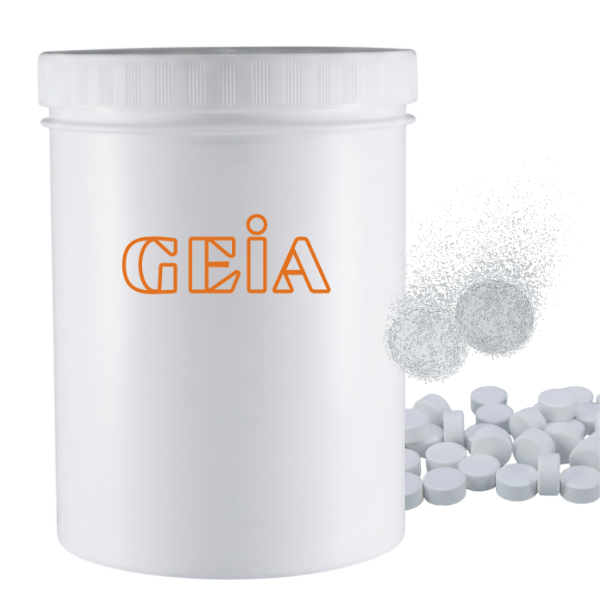
GEIA dry misting equipment is an application method for EPA-registered hypochlorous disinfectants (3.3g Tablets, 6.5g Tablets). The EPA-registered tablets carry the regulatory backing infection prevention committees evaluate. Many hospitals have already integrated GEIA into their protocols — Piedmont Henry being one published example.
Yes, that's a different use case. Passive ceiling-mounted UV is designed to continuously address air at low intensity. GEIA dry misting cycles are typically on-demand active treatments — different operational pattern. Some facilities run both, with passive UV as a continuous baseline and GEIA cycles for deeper, periodic whole-space coverage.
Enterprise UV disinfection devices are a major capital purchase, and most facilities need several to cover multiple floors and shadowed zones. GEIA is materially lower per square foot of coverage and lower per cycle in consumables and labor — and one system treats the whole room instead of one line-of-sight zone at a time. We'll build the total-cost math for your specific facility — request a quote.
Yes — that's the typical evaluation pattern. We'll set up a single unit, train your team, and run a controlled comparison. ATP swabbing or biological indicator testing is a reasonable way to validate against your existing UV results, which is how Piedmont Henry ran their evaluation.
Ready to See the Difference in Your Facility?
We'll demo dry misting in your hospital wing or unit — and you can run the ATP swabs yourself.
Get a Quote